Prologue · New Delhi, 20 July 2026
On 20 July 2026, more than a lakh people gathered at Jantar Mantar and set out to walk to India's Parliament. They were met with lathis and tear gas.
It was the first day of Parliament's monsoon session, and the march had a name: Chalo Sansad, to Parliament. Delhi Police had refused permission the night before. On the day, they imposed prohibitory orders, closed five metro stations, suspended the internet around Parliament, and broke the march at the barricades with lathi charges and tear gas. The CJP said about 150 protesters were hospitalised and some 70 detained; one Delhi hospital alone logged 65 medico-legal cases, protesters and police together, by that evening.[3][4] Monsoon sessionOne of Parliament's three yearly sittings, held around July–August. Opening the protest on its first day was meant to put the exam crisis in front of the government's new agenda.
The organisers had asked marchers to carry no party flags. Instead: copies of the Constitution, and photographs of Ambedkar, Gandhi, and Bhagat Singh.[3]
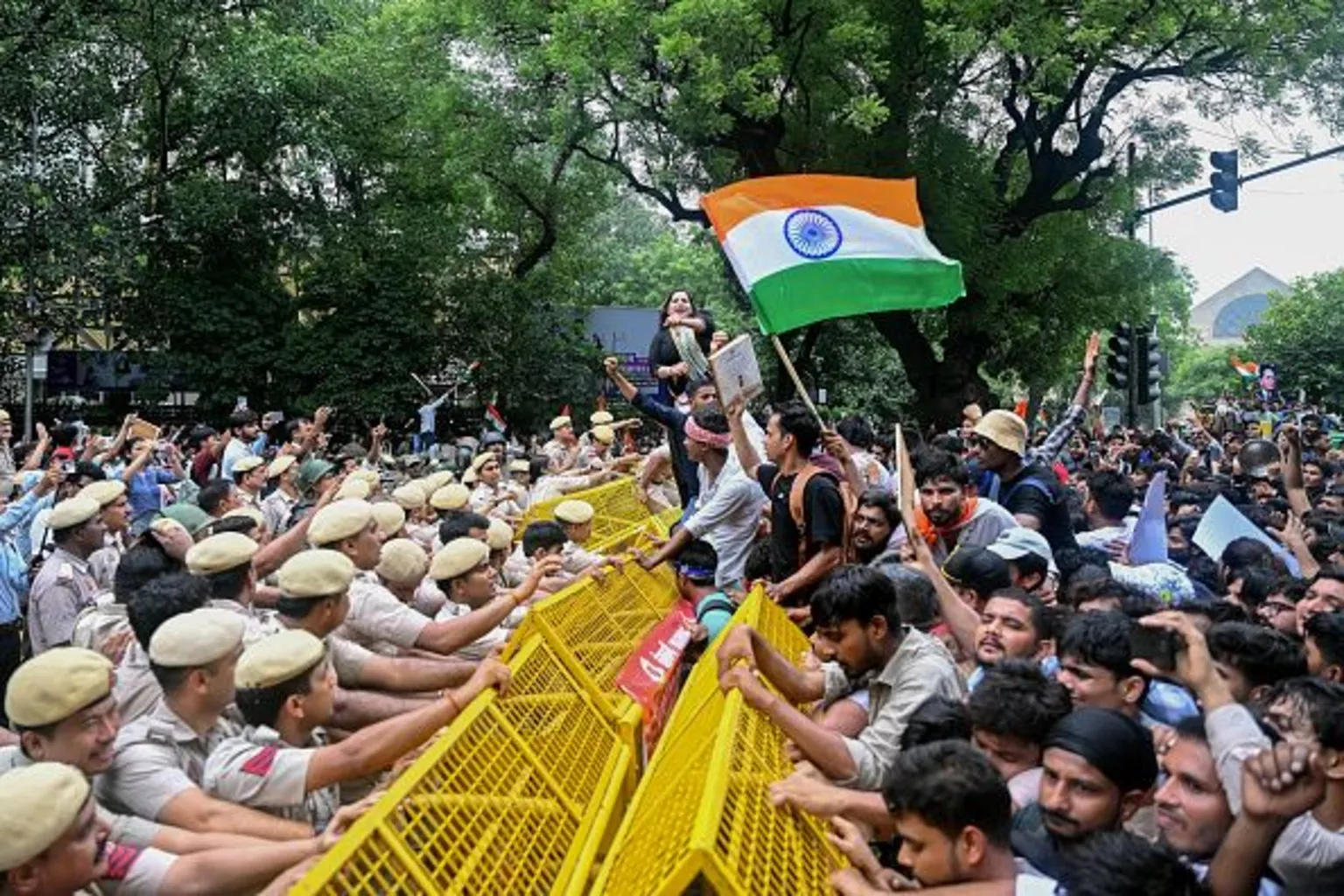
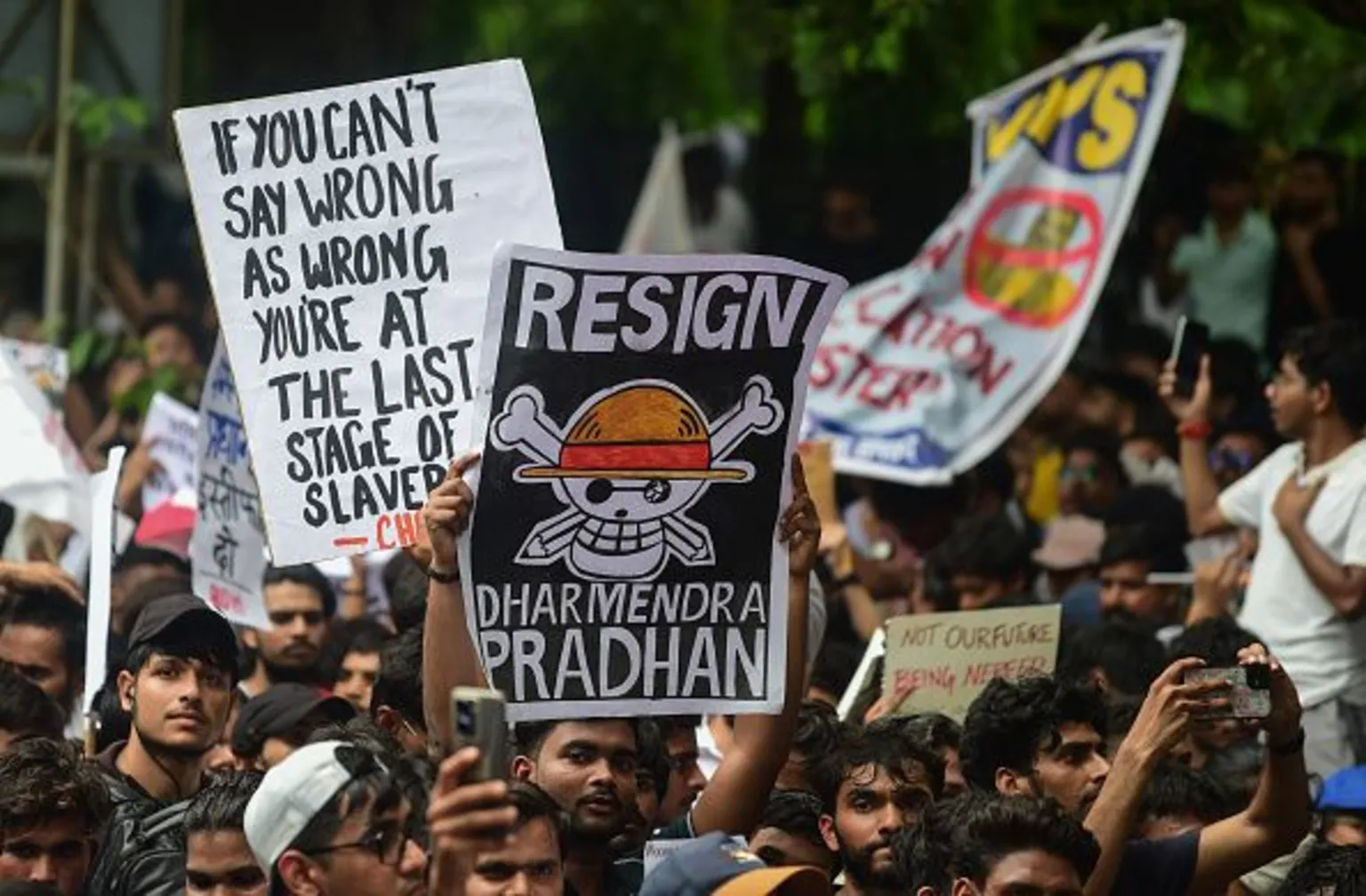
The march was called by the Cockroach Janta Party. The name is a taunt, worn on purpose. In May, during a Supreme Court hearing, the Chief Justice of India compared certain unemployed youth and social-media activists to “cockroaches” and “parasites.” He later clarified that he had meant people with fraudulent credentials. It was too late. Within days, a digital-communications strategist named Abhijeet Dipke had founded a satirical youth movement that took the insult as its name, and it spread.[3] CJPThe Cockroach Janta Party. Not a registered political party but a satirical protest movement, founded 16 May 2026. It called the 20 July march, but it was never the whole crowd.
Most of the people who turned out, though, belonged to none of it. Three national student unions joined the march; so did parents, doctors, lawyers and teachers, alongside a great many aspirants attached to no organisation at all. What they had in common was not a party but an exam.[3]
Since 6 June, the CJP has held Jantar Mantar, and the confrontation has escalated week by week:[3]
- 6 JunThe CJP occupies Jantar Mantar and gives Education Minister Dharmendra Pradhan a seven-day ultimatum to resign; a five-point “exam manifesto” demands ₹10,000 for every student hit by a leak.
- 20 JunThousands bang plates and spoons at the police barricades.
- 28 JunSonam Wangchuk, the Ladakhi engineer and reformer, begins an indefinite hunger strike at the site.
- 18 JulPolice remove Wangchuk, now more than 9 kg lighter and unable to stand, to hospital. A medical necessity, they say; a kidnapping, the protesters say. The movement's founder starts a fast of his own.
- 20 JulMore than a lakh people gather at Jantar Mantar; the Chalo Sansad march sets out for Parliament and is broken up with lathis and tear gas. This is the scene in the photographs above.
What are they angry about? The leak of NEET-UG 2026, the exam that decides who gets to become a doctor in India. It was one of two examination disasters that summer; the other, a marking scandal in the CBSE school boards that left thousands of students waiting on final results, is its own story, and not this one.[3] NEETThe National Eligibility cum Entrance Test. A single national exam, taken in one sitting, and the only route into undergraduate medical and dental study in India. “UG” = undergraduate.
Behind the lathis and the tear gas is a short chain of events. 22.7 lakh people sat that exam on 3 May. Nine days later it was cancelled over a leak. It was held again on 21 June, and its results are contested still.
And behind that is a longer story, which begins two years earlier. This piece is that story: how a country's biggest exam broke twice, and why so few people believe the number on their scorecard. Before 2024Two years is where this story starts, not where the problem does. The same exam was cancelled over a leak in 2004, and again in 2015. The appendix holds the record before then.
Act I
The door
Every year, more than 20 lakh Indian teenagers sit for a single exam. For most of them, it is the only way to become a doctor.
NEET is the sole entrance test for undergraduate medical and dental admission in India, and its largest entrance exam by number of applicants. On 3 May 2026, over 22.7 lakh aspirants sat for it.[1] One exam for everythingThe NMC Act of 2019 made NEET mandatory and folded in the separate entrance tests that AIIMS and JIPMER once ran of their own, so a single exam now decides nearly every medical seat in the country.
There is one test. One score. One shot a year. And far fewer seats than applicants.
22.7 lakh+ applicants. Roughly 1.1 lakh MBBS seats (approximate figure). About 1 in 20 gets through.
This is everyone who showed up. Each dot stands for about 2,300 students: a field of 22.7 lakh people, most of them teenagers, many on their second or third attempt.
And this is the door. Roughly 1.1 lakh MBBS seats in the whole country. The figure is approximate, but the ratio is the point. About one in twenty gets through.
A door this narrow bends everything around it. Families move to coaching towns for years at a time, and the price of an advantage, any advantage, climbs to meet what parents will pay.
Whether that makes the exam the disease or the cure is the oldest argument in Indian education:
Both arguments are really about the same thing: money. NEET didn't take money out of medical admission. It moved it, from buying the seat to buying the preparation. A leak breaks even that. It corrupts the one thing the exam was built to be: the same test, blind, for everyone. In 2024, that is exactly what happened.
Act II
The first crack
The leak that took down the 2026 exam was not the first. To understand it, and the anger in the prologue, you have to go back to 2024.
On 5 May 2024, roughly 23–24 lakh candidates sat NEET-UG at 4,750 centres across 571 cities. By evening, posts alleging a leak were circulating; the NTA denied them. But that same day, acting on a whistleblower's tip, Patna police filed a criminal case against thirteen people, four of them examinees. The going rate for advance access to the paper, investigators would later say, was ₹30 to ₹50 lakh per candidate.[2] NTAThe National Testing Agency, the central-government body that conducts NEET and most other big national entrance exams. When this story says “the exam's administrators,” it means the NTA.
What the CBI later reconstructed, at Oasis Public School in Hazaribagh, Jharkhand, reads like a heist, and every step of it happened before the exam began.[2]
- 8:02 am A man enters the school's unlocked strong room, opens a locker, photographs the sealed question paper, and reseals the packet with a lighter.
- 9:23 am The photographs reach a guest house nearby.
- 10:40 am A team of “solvers,” MBBS students from AIIMS Patna and RIMS Ranchi, has the full answer key ready. Candidates who paid memorise it before walking in.
The exam began at 2 pm.
Investigators would later identify 155 students who bought that paper. Of them, only two scored above 570 out of 720.[2] Scored out of 720NEET has 180 questions worth four marks each, 720 in total, with one mark deducted for a wrong answer. 570 is a strong score, but well short of the top. Even holding the real paper, most buyers did not convert it.
And Hazaribagh was not alone. In Godhra, Gujarat, the same day, a teacher serving as a centre's deputy superintendent allegedly took ₹10 lakh a candidate to fill in answer sheets after the exam; ₹7 lakh in cash was recovered from his car. The 2024 breach was never a single leak; it was an ecosystem.[2]
That is the leak itself, as investigators pieced it together. What follows is the sequence the public lived through, from exam day to the verdict. Scroll through it.
A timeline of 2024: exam day and the first leak allegations (5 May), results declared ten days early (4 June), a court challenge, the leak traced to Hazaribagh with arrests following, a government shakeup (20–22 June), a re-test for the grace-mark candidates only (23 June), the Supreme Court calling the exam “compromised” (8 July), and the verdict (23 July / 2 August).
5 May. Exam day. Around 23–24 lakh candidates, 4,750 centres, 571 cities. By nightfall: leak allegations online, and an official denial.
4 June. Results, declared ten days early, on the same day as the general-election results. The coincidence fed every suspicion. An unprecedented 67 candidates score a perfect 720. Six of them are tied to a single centre in Haryana. Neither traces back to the stolen paper from Hazaribagh; these are separate failures landing in the same results. And 1,563 candidates, it emerges, were quietly awarded grace marks for “loss of time,” producing scores of 718 and 719 that are mathematically impossible under the marking scheme.
The challenge. Educators and parents take the grace-marks policy to the Supreme Court. On 13 June, the Court cancels all 1,563 scorecards: the marks are withdrawn, and those candidates alone are offered a re-test.
The leak, on the record. Bihar Police's Economic Offences Unit hands the case to the CBI, which formally traces the breach to that one school in Hazaribagh. Its principal and vice-principal, who ran the exam there as city coordinator and centre superintendent, are among at least 36 arrested. This is the leak the entire verdict will turn on.
20–22 June. The shakeup. The education minister takes “moral responsibility” and announces a reform committee. A new anti-cheating law, carrying ten years and a ₹1 crore fine, is brought into force overnight. The NTA's director-general is removed.
And then it happened again, to a different exam. That same week, UGC-NET, a separate national test for university teaching posts, was cancelled after its paper surfaced on the Darknet. Two national exams, compromised inside two months, by the same agency.
23 June. A re-test is held, but only for the 1,563 whose grace-mark scores were cancelled, not for the whole exam. Of them, just 813 turn up. Every other result stands, for now, while the Court decides whether the exam holds.
8 July. A bench headed by the Chief Justice observes that the exam was “compromised” by the leak, and orders the CBI to report on how far it spread. Everything now hangs on that question.
23 July. The verdict. Before you read it, consider what you would have done.
A decision
It is July 2024. The leak is real; the CBI has the strong-room timeline. But on the evidence it is confined to two cities, and 23 lakh students are holding results. You are the Court. What do you do?
What the Court did
It let the results stand. The leak was “not in dispute,” the Supreme Court held, but it was confined to Patna and Hazaribagh, with “no indication that it was widespread enough to affect the exam as a whole,” and a full re-test would gravely disrupt 23 lakh students who did nothing wrong.[2][8]
In its detailed judgment of 2 August 2024, the Court also criticised the National Testing Agency for its “flip-flops,” and directed that the deficiencies be rectified “this year itself so that it is not repeated.”[8]
An exam whose answer key could be litigated to the country's highest court, whose grace marks produced impossible scores, whose paper was photographed in a strong room hours before it began: that was NEET in 2024. The Court's judgment, considered and defensible, was that the damage was local and fixable. It ordered the deficiencies rectified “this year itself so that it is not repeated.”
Act III
The fix
The system responded. A committee was formed. A law came into force. A plan was written.
The law first: the Public Examinations (Prevention of Unfair Means) Act, passed by Parliament in February 2024 and brought into force on 21 June, in the middle of the crisis. Organised exam malpractice now carries up to ten years in prison and fines up to ₹1 crore.[2]
Then the plan. In June 2024 the Ministry of Education constituted a seven-member expert committee under former ISRO chief Dr K. Radhakrishnan, its members including a former director of AIIMS, and put the question to the public.[2]
37,144 people wrote in. Students, parents, teachers and academics, filing submissions through a government portal on how the exam that governs their lives ought to be run. The committee's report, Reformation of National Common Entrance Testing in India, was submitted on 21 October 2024 and made public that December.[9] CBTComputer-based testing: the exam delivered on screen at a proctored centre, the way India already runs its engineering entrance (JEE). No printed paper means no printing press, no transport, no strong room: the entire physical chain that leaked is deleted.
It ran to 101 recommendations, across short-, medium- and long-term horizons. These are the promises. Each card says what was recommended, and what it was meant to prevent.
01Computer-based testing
Move NEET to computer-based testing (CBT), hybrid where needed, so there is no physical paper to intercept, photograph, or sell.
02Restructure the NTA
Three dedicated sub-committees inside the testing agency: Test Audit; Ethics & Transparency; Nomination, Staff Conditions & Stakeholder Relationships.
03Permanent staff
Shift from heavy reliance on contractual staff to permanent staff, people accountable to the institution rather than to a vendor.
04Fewer private centres
Reduce dependence on private third-party test centres; expand government-run centres.
05Schools as test centres
Convert Kendriya Vidyalayas and Jawahar Navodaya Vidyalayas into CBT centres: a network of 400–500 centres with roughly 2–2.5 lakh testing capacity in a single session, within about a year.
06A presiding officer
An NTA presiding officer in overall charge at every centre: one accountable person in the room. In Hazaribagh, remember, the centre's own superintendent was in on it.
07Mobile testing centres
Mobile Testing Centres so rural and remote candidates are not pushed to distant, harder-to-secure venues.
08Security & support
Data-security upgrades, technological safeguards, and mental-health support for candidates.
And things visibly happened. A High-Powered Steering Committee was constituted on 14 November 2024 to oversee implementation. State- and district-level coordination committees were set up. Multi-layer frisking, expanded CCTV, mobile jammers and data-analytics anomaly detection were all reported as implemented.[10]
Then, on 2 January 2025, the Centre gave the Supreme Court its word: every corrective measure would be implemented.[9][10]
On paper, the problem had been solved.
Act IV
Again
On 3 May 2026, over 20 lakh students sat down again. Within days, it was clear the fix had not held.
In the coaching hubs, notably Sikar in Rajasthan, a “guess paper” had been circulating before exam day, sold through paid WhatsApp groups. It was not a rumour but an actual PDF. And when a chemistry teacher named Shashikant Suthar lined it up against the real paper, the matches kept coming.[6][7]
A grid of 180 cells, one per question on the real paper. Up to about 120 of them, concentrated in Chemistry and Biology, matched the pre-circulated “guess paper.”
This is the real paper. 180 questions: Physics, Chemistry, Botany, Zoology. Every cell is one question that 22.7 lakh students answered on 3 May.
Now lay the “guess paper” on top of it, the way Suthar did. The red cells are matches: questions that appeared in the material sold on WhatsApp before the exam.
The matches kept coming, concentrated in Chemistry and Biology. A coaching class predicting topics gets the syllabus right. This had the paper itself.
Up to 120 of 180 questions, by ThePrint's count. Suthar himself counted around 140. Either way, this was not a marginal overlap, and it was not contained.
Suthar compared the circulating material to the official paper and alerted the authorities. The Rajasthan Police Special Operations Group opened the investigation; on 12 May 2026 the case was transferred to the CBI. That same day, the NTA cancelled the exam, “in the interest of students,” it said, and to protect the credibility of the exam system. Fees refunded. No re-registration; the same candidates, the same centres. On 15 May, a re-exam was announced for 21 June.[1]
The arrests, when they came, sketched a racket that ran through the exam's own bloodstream, from NTA insiders out to coaching classes and buyers:[1]
The paper translator · Pune
A chemistry professor who had worked for the NTA translating the paper. Accused of running “special classes” before exam day in which he dictated questions, with their answers.
The subject expert · Pune
A school headmistress with NTA subject-expert access. The CBI says it recovered question papers, copies of NTA identity cards, and cash from her home.
The coaching owner · Latur
Investigators say he had the chemistry questions on 23 April, ten days before the exam. At one institute, 42 of 45 “mock paper” questions matched the real test.
The buyers · Nashik & Latur
A Nashik doctor accused of selling papers for ₹15 lakh; a group of Latur doctors accused of paying ₹2–10 lakh apiece, for their own relatives.
All are accused, not convicted; this piece names only the whistleblower, who came forward publicly.
Those are a lot of unfamiliar towns to hold at once, so it is worth seeing them on a map.
- 2024 · Hazaribagh, Jharkhand: the strong room, where the paper was photographed at 8:02 am.
- 2024 · Patna, Bihar: the first criminal case, filed on exam day.
- 2024 · Godhra, Gujarat: a separate racket, filling in answer sheets after the exam.
- 2024 · Haryana: one centre produced six of the 67 perfect scores.
- 2026 · Sikar, Rajasthan: the coaching town where the “guess paper” circulated.
- 2026 · Pune, Maharashtra: the paper translator and a subject expert, both with NTA access.
- 2026 · Latur, Maharashtra: a coaching owner with the chemistry questions ten days early.
- 2026 · Nashik, Maharashtra: a doctor accused of selling papers.
- 2026 · Ahmedabad, Gujarat: men arrested selling fake leaked papers.
2024. The leak the Supreme Court ruled on came down to two cities about 150 kilometres apart, Hazaribagh and Patna. That is what the Court meant by “no indication that it was widespread enough to affect the exam as a whole.” Godhra and a Haryana centre sat outside that finding, as separate problems.
2026. The same map, two years later. Five sites across three states, and the distance is the point: this was not one school gone bad but a chain running from a coaching town in Rajasthan to insiders in Pune and buyers in Latur and Nashik.
Education Minister Dharmendra Pradhan conceded a “breach in the command chain” and announced that NEET would go fully computer-based from 2027.[1]
Then the CBI found something worse. There was evidence that the same operation had compromised the 2025 paper too, the exam held in between, and the first one after the fix. The year everyone believed had gone cleanly had not gone cleanly; it had only gone uncaught.[1]
The assurance to the Supreme Court was given in January 2025. The paper that year leaked anyway, and nobody knew until the CBI went looking for something else.
Act V
Why trust collapsed
Everything in Act III was supposed to prevent Act IV.
Here is the ledger. On the left, what was promised after 2024. On the right, what happened in 2026. Read across each row.
Move to computer-based testing, so there is no physical paper to steal.
NEET-UG 2026 was still pen-and-paper. A “guess paper” matching up to ~120 of 180 questions sold in WhatsApp groups before exam day.
Restructure the NTA: audits, an ethics committee, permanent staff, a tighter chain of custody.
The accused included NTA insiders: a paper translator, a subject expert. The minister conceded a “breach in the command chain.”
2 January 2025: the Centre assured the Supreme Court that every corrective measure would be implemented.
25 May 2026: the Court had to demand a status report. The reforms that landed guarded the exam hall; the paper's route to it was left alone.
On 25 May 2026, hearing the fallout of the cancellation, the Supreme Court pulled up the NTA and asked a simple question: had the 2024 committee's recommendations ever actually been implemented? It sought a formal status report.[11] The affidavit that came back was not empty. Most of the 101 had been implemented or were in progress, the committee's own chair told the Court: state and district coordination committees running through the 2025 and 2026 exams, sixteen new senior posts filled by specialists from the IITs, the UGC and the Kendriya Vidyalaya system, and more than 99.5 per cent of NEET-UG 2026 centres held inside government institutions rather than private ones.[10]
Every one of those measures guards the examination hall. The 2026 paper never went near one. It left through a translator and a subject expert who already had legitimate access, weeks before any candidate sat down.[1] The recommendations covering that stretch of the chain were the ones still outstanding: question papers encrypted, transmitted digitally and printed on site; a “Digi-exam” system for tracking candidate identity; Red Team and Blue Team stress-testing by ethical hackers. For the job of moving a paper to the hall, the agency stayed with a physical logistics chain outsourced to private contractors.[17] The reforms had hardened the room and left the road to it alone.
Reactions arrived from every direction, each of them arguing for something its speaker already wanted.[1]
And consider what it took to hold the second exam. The paper-setters, translators, and moderators were sequestered at an undisclosed location, their devices restricted. On the Defence Minister's advice, the Indian Air Force flew the question papers to their distribution points. The government blocked Telegram across India from 16 to 22 June, a move the Delhi High Court upheld, to slow the spread of anything claiming to be the paper. In Ahmedabad, police arrested two men selling fake “leaked papers” for an exam whose real paper had already leaked once.[1]
Moving a single exam paper across India now required the air force.
For the candidates, all of that arrived as six more weeks of peak preparation, a second exam day, the same syllabus, and less reason to trust the result.[15]
At least 21 students are reported to have died by suicide amid the leak and its aftermath.[1]
That number sits inside a much larger one. India's National Crime Records Bureau recorded just over 8,000 student suicides in 2014. In 2024 it recorded 14,488, a rise of close to 80 per cent in ten years. Across that decade more than 1.23 lakh students died, and more than a fifth of those deaths were logged against one cause: failure in an examination. That is upwards of 2,000 students a year, in years with a leak and years without.[22]
More than a fifth of the decade's deaths were recorded against failure in an examination.[22]
The Bureau records a cause against each death. Failure in an examination is one of them. A leaked paper is not.
Where it stands · verified 20 July 2026
- The Supreme Court refused to stay the re-exam, and rejected pleas to hold it as a computer-based test. It went ahead on 21 June 2026, on pen and paper again.[1]
- Results of the re-exam were declared on 16 July 2026; about 11.2 lakh candidates qualified. Post-result complaints allege OMR-sheet mismatches; the NTA says many of the complaint sheets are fake.[1][15]
- The Court deferred further hearings, on the re-exam challenges and the NTA's accountability, to late July 2026. The status-report question is still open.[11]
- And on 20 July, the day in the prologue, more than a lakh people gathered at Jantar Mantar, and the “Chalo Sansad” march was broken up with lathis and tear gas outside Parliament, on the first day of the monsoon session. The protest has outgrown the exam.[3][4]
Coda
The door has not moved
Return to where we began: the same field, the same narrow door. Nothing in two years of leaks, committees, and courtrooms has widened it.
The same field of a thousand dots from Act I: 22.7 lakh applicants, a sliver of seats. About one in twenty.
Every May, more than 20 lakh sit down again, including many who sat the year before, and the year before that. The exam will be held. Computer-based testing is promised again, for 2027. The question left unanswered by every reform is the simplest one: can they believe the result?
Update · 25 July 2026
Seven weeks after the protest began at Jantar Mantar, Education Minister Dharmendra Pradhan resigned. He announced it on X on 25 July, saying he had sent his letter to Prime Minister Narendra Modi “considering the situation that has developed at Jantar Mantar and across the country,” and that he respected “the aspirations, feelings, and legitimate expectations of the country's youth.” [23][3]
The Cockroach Janta Party called off the protest the same day, at a joint press conference with two union ministers. “All our demands have been accepted,” its spokesman said, asking protesters to withdraw and go home.[23]
The undertakings, as reported: police cases against protesters withdrawn in NDA-ruled states, and no further action against them; maximum compensation for the families of students who died by suicide; fast-track courts for paper-leak cases; amendments to the Public Examinations (Prevention of Unfair Means) Act, 2024; and talks on preventing leaks.[3][23]
Every one of those addresses what happens after a paper leaks, or what happens to the people who protested. None of them changes how a question paper travels from the printer to the examination hall. That is the stretch that failed in 2024, and again in 2026.
Appendix
Before 2024
This piece covers two exams, in 2024 and 2026. Neither was the first.
What follows is not part of the story. It is the record the story sits on. Reviewing two decades of Indian public examinations in July 2026, The Tribune counted more than 90 leaks and irregularities at national and state level, at least 15 of them in exams run by central agencies.[20]
- 2004 The All India Pre-Medical Test, the exam NEET replaced, is cancelled after its paper leaks, and held again. When the Court weighs cancelling the exam eleven years later, this is the precedent it has for re-running a national entrance test at short notice.[20]
- 2006 A pen-shaped scanner is used to copy the paper out of the hall during the AIIMS postgraduate entrance. Fifty-two people are chargesheeted.[20]
- 2007 to 2013 Vyapam, Madhya Pradesh. The state's professional examination board rigs its Pre-Medical Test, and a dozen other exams, at industrial scale. Paid impersonators sit in place of candidates. An “engine-bogie” seating pattern places a strong candidate between two weak ones so answers can be copied in both directions. By June 2015 more than 2,000 people have been arrested, among them a former state education minister. The Supreme Court hands the case to the CBI in July 2015, and in February 2017 cancels the degrees of 634 doctors admitted through it, holding that “fraud cannot be allowed to trounce, on the stratagem of public good.” A state police task force recorded 23 unnatural deaths among people connected to the case; other counts run higher, and the figure is contested.[18]
- 2011 The AIIMS postgraduate exam is compromised again, this time through a Bluetooth earpiece racket.[20]
- 2015 AIPMT. Answer keys reach candidates during the exam on 3 May, through vests fitted with SIM units and Bluetooth earpieces; those arrested in Rohtak include two dentists and a medical student. On 15 June the Supreme Court cancels the exam for the whole country, holding that “the examination stands vitiated even if one student is being benefited illegally,” and orders a re-test. It is held on 25 July. About 6.3 lakh had sat the original exam. About 4.2 lakh come back for the second one.[19]
- 2017 NEET-UG. Arrests in Patna and Panaji over attempts to leak the paper or to sit it in someone else's place. Candidates are reported to have been charged between ₹10 lakh and ₹30 lakh. CBSE, which ran the exam then, denies any systemic leak and says much of what changed hands was fake. The following year the exam passes to the National Testing Agency.[21]
- 2021 NEET-UG. At a centre in Jaipur, an invigilator is accused of photographing sections of the paper during the exam and sending them out to solver gangs, who work the answers and route them back to selected candidates. Eight people are arrested. The Supreme Court declines to order a re-exam.[21]